Voltage Explained: What It Means for Tankless Water Heaters
As an Amazon Associate we earn from qualifying purchases. Links on this page are affiliate links.
Voltage Explained for Tankless Heaters
Voltage is the electrical pressure that pushes current through your water heater. It determines how much power the unit can draw to heat water on demand. When you look at tankless water heaters, you will see two main voltage ratings: 240V and 120V. Understanding voltage explained helps you choose the right unit for your home's electrical system.
Most whole-house tankless water heaters require 240V. This higher voltage allows the unit to pull more amperage and deliver more energy. The result is a faster flow rate of hot water. You can typically shower comfortably with a 240V model. These units are designed for standard residential circuits that provide double-pole breakers. Check your electrical panel to see if you have the necessary space and capacity for a 240V connection.
Some compact units operate on 120V. These are often point-of-use heaters for sinks or small bathrooms. Because the voltage is lower, the power output is also lower. You will get a smaller flow of hot water. These units are easier to install because they plug into standard outlets. However, they may struggle to heat water during cold weather or if you need high flow.
When shopping, look at the product specifications for the exact voltage rating. The label will clearly state 120V or 240V. Do not guess. Connecting a 240V unit to a 120V circuit will result in no heat. Connecting a 120V unit to a 240V circuit will damage the unit immediately. Always match the voltage to your home's supply. This spec is critical for safety and performance. It dictates the wiring, breaker size, and overall functionality of your new heater.
240V vs 120V Options
240V
240V units draw more power, enabling higher flow rates and whole-house coverage. Models like the Rheem 18kW and Camplux 6000W use this voltage to deliver consistent hot water for multiple fixtures. You need a dedicated 240V circuit, often requiring professional installation. This setup suits homes with strong electrical infrastructure. The trade-off is higher upfront complexity. You must verify your panel capacity. If your home lacks 240V outlets, you may need an electrician. However, the performance gain justifies the effort for most households. The Camplux TE06ProN5 offers a compact 240V option for point-of-use needs, proving that high voltage can fit in small spaces while maintaining efficiency.
120V
120V units plug into standard outlets, making installation simpler and cheaper. The Thermomate 6.5-Gallon Mini-Tank is a prime example, designed for under-sink use where tankless units lack power. This voltage suits renters or those adding a single sink. You get immediate hot water without electrical upgrades. The trade-off is lower capacity. You cannot run multiple fixtures simultaneously. Flow rates are limited. This option is ideal for localized needs like a bathroom sink or kitchen prep area. It avoids the need for new wiring. If you only need hot water for one faucet, 120V is practical. It removes the barrier of complex electrical work. However, do not expect whole-house performance from this voltage level.
Is a Tankless Heater Worth It
Who needs it
You need 240V if you want reliable hot water for multiple uses at once. Higher voltage allows the unit to draw more power, which directly increases the flow rate. This means you can run a shower and the kitchen sink simultaneously without the temperature dropping. If your household has more than one bathroom or if you live in a colder climate, the 240V model is essential. It ensures consistent performance during peak usage times. The extra electrical capacity supports higher kilowatt ratings, providing enough heated water for a whole house. Without this voltage, you might experience cold spots or insufficient flow. Check your electrical panel first. You must have a dedicated 240V circuit with the correct amperage breaker. If your home lacks this setup, installing it requires an electrician. The upfront electrical work is necessary to get the performance you expect from a modern tankless system.
Who can skip it
Skip the 240V upgrade if you only need hot water for a single point of use. The 120V option is sufficient for small spaces like a bathroom sink or a remote cabin. These units plug into standard outlets, so you do not need special wiring or a new breaker. If you are on a tight budget for electrical upgrades, the 120V model saves you money and time. You can install it yourself without hiring a professional electrician. Prioritize flow rate requirements over voltage ratings if you only need one fixture at a time. Look for compact designs that fit under small sinks. Consider the installation ease and the existing electrical infrastructure in your home. If you do not need high flow, the lower voltage unit meets your needs perfectly. It is a practical choice for low-demand applications where simplicity matters more than high capacity.
Voltage Glossary Terms
Voltage
Electrical pressure pushing current through the heater. Higher voltage allows more power draw, enabling faster water heating and higher flow rates for your home.
240V
Standard residential voltage for most tankless heaters. It provides enough power for whole-house use and simultaneous fixture operation without dropping water temperature.
120V
Lower voltage suitable for point-of-use heaters. These units typically serve single sinks or showers with limited flow rates and lower power output.
Wattage
Power consumption measured in watts. It indicates how much energy the heater uses to raise water temperature. Higher wattage usually means faster heating.
Flow Rate
Volume of hot water delivered per minute. Voltage and wattage directly impact this spec. Higher voltage supports greater flow rates for multiple fixtures.
Circuit
Path electricity takes from the panel to the heater. 240V units require dedicated circuits with specific amperage ratings to handle the electrical load safely.
Quick picks
Our 6 picks
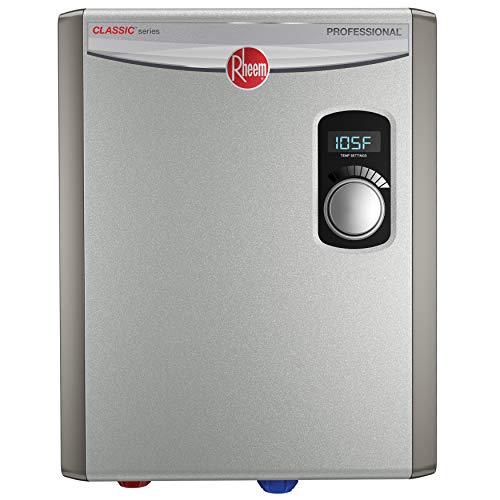
Rheem 18kW 240V Electric Tankless Water Heater
Best for: whole-house heating with 240V power
- Voltage
- 240V (what this guide is about)
- Fuel Type
- Electric
- Flow Rate
- 4.4 GPM
- Wattage
- 18 kW
- Temperature Control
- ±1°F
- Dimensions
- 3.5 x 14.5 x 18.5 inches
View on Amazon: Rheem 18kW 240V Electric Tankless Water Heater Affiliate link
This Rheem unit delivers 18 kW of power at 240 volts, targeting whole-house needs. It reaches up to 4.4 GPM with copper immersion elements. You get an external digital thermostat with ±1°F accuracy. The self-modulating technology adjusts power to match demand. Its compact 3.5-inch height fits tight spaces. This model suits households seeking steady hot water flow without large storage tanks.
Pros
- 18 kW output at 240V for whole-house use
- Up to 4.4 GPM flow rate
- Digital control with ±1°F temperature accuracy
- Self-modulating power adjustment for efficiency
- Slim 3.5-inch depth fits tight spaces
Cons
- Requires 240V electrical circuit
- 14.8 lbs weight needs sturdy mounting
- No remote control included
Good fit if
- You have a 240V electrical supply
- You need a whole-house solution
- You want precise temperature control
Skip if
- You only have 120V outlets
- You need point-of-use under-sink heating
- You want a remote control
Verdict: Rheem 18kW 240V Tankless Heater fits homes needing high flow rates. It works best for whole-house heating where 240V power is available.

Thermomate 6.5-Gallon Under-Sink Electric Mini-Tank
Best for: single sink point-of-use applications
- Voltage
- 120V (what this guide is about)
- Fuel Type
- Electric
- Wattage
- 1.44 kW
- Capacity
- 6.5 Gallons
- Temperature Control
- 50°F to 149°F
- Certification
- UL Listed
View on Amazon: Thermomate 6.5-Gallon Under-Sink Electric Mini-Tank Affiliate link
This ThermoMate unit is a 6.5-gallon electric mini tank designed for point-of-use installation. It operates on a standard 120V outlet with a 1.44 kW heating element, drawing 12 amps. The glass-lined tank offers 99% thermal efficiency and includes a thermostat ranging from 50°F to 149°F. Its compact 17.7 x 17.7 x 14.6-inch footprint allows for under-sink mounting. You get instant hot water with fast recovery and freeze protection mode.
Pros
- Plugs into standard 120V outlets
- 99% thermal efficiency for reduced standby loss
- Adjustable thermostat from 50°F to 149°F
- UL Listed for safety certification
- Includes freeze mode to prevent tank damage
Cons
- 1.44 kW output is lower than 240V tankless models
- 6.5-gallon capacity limits simultaneous use
- 1-year parts warranty is shorter than tank warranty
Good fit if
- You need hot water for a single sink
- You have only a 120V circuit available
- You want a compact under-sink heater
Skip if
- You require high flow for showers
- You need continuous hot water supply
- You want to install on a 240V line
Verdict: ThermoMate 6.5 Gal 120V Mini Tank fits renters or homeowners needing localized hot water without electrical upgrades. It delivers reliable performance for sinks where tankless units lack power or space.

Camplux 6000W 240V Point-of-Use Tankless Water Heater
Best for: single sink point-of-use installations
- Voltage
- 240V (what this guide is about)
- Fuel Type
- Electric
- Flow Rate
- 1.07 GPM at 35°F rise
- Wattage
- 6000 W
- Certification
- ETL Listed
- Dimensions
- 10.95 x 7.4 x 2.52 inches
View on Amazon: Camplux 6000W 240V Point-of-Use Tankless Water Heater Affiliate link
The Camplux TE06ProN5 is a compact 240V electric tankless heater designed for point-of-use installation. It delivers 6000W of heating power, providing hot water in about three seconds. The unit measures 10.95 by 7.4 by 2.52 inches and weighs 4.9 pounds, fitting easily under sinks. It offers a flow rate of 1.07 GPM at a 35°F temperature rise. This model is ideal for single faucets where space is limited.
Pros
- 240V voltage for efficient heating
- Compact dimensions fit tight spaces
- LCD display shows real-time temperature
- Self-modulating technology adjusts power
- ETL Listed for safety certification
Cons
- Low flow rate of 1.07 GPM
- Limited to single-point applications
- No remote control included
Good fit if
- You need a heater for a single sink
- You have limited space under a counter
- You want instant hot water on demand
Skip if
- You need hot water for multiple fixtures
- You require a high flow rate
- You only have a 120V outlet
Verdict: Camplux 6000W 240V Electric Tankless is a practical solution for under-sink installations. It suits users who need reliable hot water for a single faucet in a compact footprint.

VEVOR 30-Gallon 5000W Electric Water Heater
Best for: families needing high-volume hot water
- Voltage
- 240V (what this guide is about)
- Fuel Type
- Electric
- Wattage
- 5000 W
- Capacity
- 30 gal
- Dimensions
- 40.2 x 17.7 x 17.7 inches
- Use
- Commercial
View on Amazon: VEVOR 30-Gallon 5000W Electric Water Heater Affiliate link
This VEVOR unit is a 30-gallon electric tankless water heater running on 240V with 5000W heating power. It features a 20 mm foam insulation layer to reduce heat loss and an enamel interior for corrosion resistance. The LED display and rotary knob allow for easy temperature adjustment. It fits 3-4 outlets, making it suitable for families of 3-5 people or small commercial use.
Pros
- 30-gallon capacity supports simultaneous use at 3-4 water outlets
- 20 mm thick foam insulation minimizes heat loss
- LED display shows heating status clearly
- Enamel interior resists corrosion and high temperatures
Cons
- Larger physical footprint at 40.2 x 17.7 x 17.7 inches
- Heavier build at 74.5 pounds
- Only 5000W heating power compared to higher-kW models
Good fit if
- You need a 240V electric unit for a family of 3-5
- You want to supply hot water to multiple outlets simultaneously
- You prefer simple rotary knob controls with an LED display
Skip if
- You require a compact point-of-use heater under 10 gallons
- You need a 120V unit for standard household circuits
- You want a model with smart app connectivity
Verdict: VEVOR 30-Gallon 240V Electric Water Heater is a solid choice for households needing reliable, simultaneous hot water across multiple fixtures. Its large capacity and insulation make it practical for busy homes.
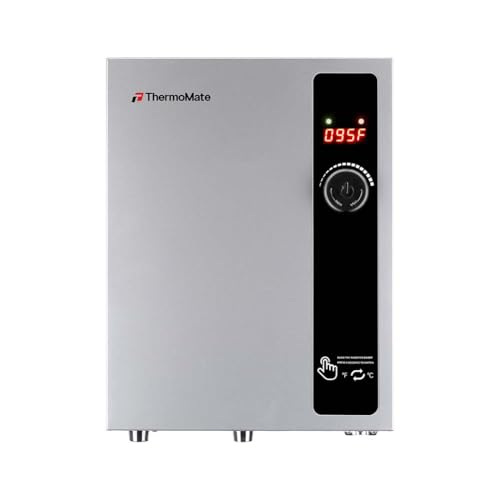
Thermomate 18kW Electric Tankless Water Heater
Best for: Whole-house hot water with high electrical capacity
- Voltage
- 240V (what this guide is about)
- Fuel Type
- Electric
- Flow Rate
- Up to 4.4GMP
- Wattage
- 18kW
- Installation Location
- Indoor
- Temperature Control
- 80°F to 140°F, ±1°F
View on Amazon: Thermomate 18kW Electric Tankless Water Heater Affiliate link
The ThermoMate 18kW unit delivers up to 4.4 GPM at 240V. It uses self-modulating technology to adjust energy use based on inlet water temperature and flow. The digital display allows precise temperature control in 1-degree increments from 80°F to 140°F. This compact, wall-mounted heater fits tight spaces and includes ETL certification for safety. It suits users needing high flow rates for multiple fixtures.
Pros
- 18kW power output at 240V
- Up to 4.4 GPM flow rate
- Digital display with 1-degree increments
- Self-modulating energy efficiency
- ETL certified safety
Cons
- Requires 80Amp breaker setup
- High amperage draw limits circuit options
- Indoor installation only
Good fit if
- You need high flow for whole-house use
- You have a 240V electrical panel with sufficient capacity
- You want precise temperature control
Skip if
- You only have 120V outlets available
- Your electrical panel cannot support an 80Amp breaker
- You need outdoor installation
Verdict: ThermoMate 18kW 240V Electric Tankless provides strong performance for homes with adequate electrical infrastructure. It is ideal for users requiring high flow rates and precise temperature settings.

ThermoMate 14kW Electric Tankless Water Heater
Best for: 1-2 fixture simultaneous use with 240V power
- Voltage
- 240V (what this guide is about)
- Fuel Type
- Electric
- Flow Rate
- 3.4 GPM
- Wattage
- 14 kW
- Installation Location
- Indoor
- Temperature Control
- 86°F to 131°F
View on Amazon: ThermoMate 14kW Electric Tankless Water Heater Affiliate link
This ThermoMate unit delivers 3.4 GPM at 14 kW on a 240V circuit. It uses a cast aluminum heating block for durability and features a touch control panel. The compact design fits indoor spaces, measuring 15.9 by 11.2 by 3 inches. It stabilizes water temperature between 86°F and 131°F. You get endless hot water for one or two fixtures. The 60 Amp requirement ensures high performance for whole-house or multi-point supply.
Pros
- 14 kW output provides 3.4 GPM flow rate
- Cast aluminum heating block resists scale and corrosion
- ETL listed for UL-499 and CAN/CSA-C22.2 safety
- Compact 15.9 x 11.2 x 3 inch footprint
- Touch control with smart modulation for temp stability
Cons
- Requires a dedicated 60 Amp double-pole circuit breaker
- Limited to indoor installation only
- Flow rate supports only 1-2 fixtures simultaneously
Good fit if
- You have a 240V electrical panel with 150 Amps total capacity
- You need hot water for a shower and one sink
- You want a compact unit for a tight closet or small home
Skip if
- You only have a 120V outlet available
- You need to run three or more fixtures at once
- You require outdoor installation capability
Verdict: ThermoMate 14kW 240V Electric Tankless Heater suits homes with strong electrical infrastructure that need reliable hot water for one or two bathrooms. It offers durable heating elements and safety certifications in a small package.
Specifications side by side
| Spec | Rheem 18kW 240V Electric Tankless Water Heater | Thermomate 6.5-Gallon Under-Sink Electric Mini-Tank | Camplux 6000W 240V Point-of-Use Tankless Water Heater | VEVOR 30-Gallon 5000W Electric Water Heater | Thermomate 18kW Electric Tankless Water Heater | ThermoMate 14kW Electric Tankless Water Heater |
|---|---|---|---|---|---|---|
| Fuel Type | Electric | Electric | Electric | Electric | Electric | Electric |
| Flow Rate | 4.4 GPM | not stated | 1.07 GPM at 35°F rise | not stated | Up to 4.4GMP | 3.4 GPM |
| Wattage | 18 kW | 1.44 kW | 6000 W | 5000 W | 18kW | 14 kW |
| Installation Location | not stated | not stated | not stated | not stated | Indoor | Indoor |
| Capacity | not stated | 6.5 Gallons | not stated | 30 gal | not stated | not stated |
| Voltage | 240 V | 120V | 240 V | 240 V | 240V | 240 V |
| Temperature Control | ±1°F | 50°F to 149°F | not stated | not stated | 80°F to 140°F, ±1°F | 86°F to 131°F |
| Certification | not stated | UL Listed | ETL Listed | not stated | ETL | ETL |
| Dimensions | 3.5 x 14.5 x 18.5 inches | 17.7"H x 17.7"W x 14.6"D | 10.95 x 7.4 x 2.52 inches | 40.2 x 17.7 x 17.7 inches | 17.12" x 13.12" x 3.12" | 15.9" x 11.2" x 3" |
| Use | Whole House | Under Sink | not stated | Commercial | not stated | not stated |
| Weight | 14.8 pounds | 26.5 pounds | 4.9 pounds | 74.5 pounds | not stated | 13 pounds |
| Size | Small | 6.5 Gallon | not stated | 30 Gal | 240V/18kW | not stated |
| Color | Gray | white,blue | White | Gray | Gray | Gray |
| Model | RTEX-18 | ES700 | TE06ProN5 | FJI-POR-120S2 | ET180 | EH140 |
Frequently asked questions
Can a 120V tankless heater replace a 240V unit for whole-house use?
No. A 120V unit lacks the power for whole-house heating. The Thermomate 6.5-Gallon 120V Mini-Tank is designed for single sink point-of-use applications. It fits renters or homeowners needing localized hot water without electrical upgrades. It delivers reliable performance for sinks where tankless units lack power or space. You cannot expect it to serve multiple fixtures simultaneously.
What is the maximum wattage for a 240V electric tankless water heater?
The maximum wattage listed is 18 kW. Both the Rheem 18kW and the Thermomate 18kW models operate at this level. These units fit homes needing high flow rates. They work best for whole-house heating where 240V power is available. Higher wattage allows the unit to draw more power, which directly increases the flow rate for simultaneous use.
Is a 240V circuit required for point-of-use tankless heaters?
Not always. While many point-of-use models like the Camplux 6000W use 240V, other options use 120V. The Camplux 6000W 240V Electric Tankless is a practical solution for under-sink installations. It suits users who need reliable hot water for a single faucet in a compact footprint. You must check the specific voltage rating of the model you choose.
How does voltage affect the physical size of the unit?
Voltage does not dictate size, but power output often correlates with footprint. The Rheem 18kW 240V unit measures 14.5 inches wide and 18.5 inches long. In contrast, the Camplux 6000W 240V point-of-use model is much smaller at 7 inches wide and 10 inches tall. The Thermomate 120V mini-tank is larger in volume but has a different shape. You should check the specs for your available space.
Can I use a 240V heater on a 120V circuit?
No. You must match the voltage rating of the heater to your home’s electrical supply. The Rheem 18kW and Thermomate 18kW models require 240V. The Thermomate 6.5-Gallon unit is rated for 120V. Connecting a 240V unit to a 120V circuit will prevent it from operating correctly. Always verify the voltage specification before installation.
What is the weight difference between 240V and 120V models?
Weights vary by design and capacity, not just voltage. The Rheem 18kW 240V tankless heater weighs 14.8 pounds. The Camplux 6000W 240V point-of-use unit is lighter at 4.9 pounds. The Thermomate 120V mini-tank is heavier at 26.5 pounds due to its tank. The VEVOR 30-Gallon 240V unit is the heaviest at 74.5 pounds. Check the weight spec for mounting requirements.
Do all 240V tankless heaters have the same flow rate?
No. Flow rate depends on wattage and design. The Rheem 18kW and Thermomate 18kW models offer high flow rates for whole-house use. The Camplux 6000W 240V model is for single sink point-of-use. The Thermomate 14kW 240V model suits one or two bathrooms. Higher wattage generally supports higher flow rates. You should select the wattage that matches your household’s hot water demand.
Is a 240V heater suitable for commercial use?
Some models are rated for commercial use. The VEVOR 30-Gallon 240V Electric Water Heater is listed for commercial applications. It is a solid choice for households needing reliable, simultaneous hot water across multiple fixtures. Its large capacity and insulation make it practical for busy homes. However, most tankless models in this list are for residential whole-house or point-of-use needs.