Rinnai vs Westinghouse Tankless Water Heaters: Which Brand Fits You?
As an Amazon Associate we earn from qualifying purchases. Links on this page are affiliate links.
Choosing between a rinnai vs westinghouse tankless water heater depends on your home’s infrastructure. Both brands offer on-demand hot water without a storage tank. The main difference lies in their power source and installation requirements. Rinnai uses gas for high flow rates, while Westinghouse uses electricity for compact placement. Your decision hinges on fuel availability and desired output capacity.
Key differences
| Aspect | Rinnai 11.1 GPM Condensing Dual-Fuel Water Heater | Westinghouse 24kW WiFi Tankless Water Heater |
|---|---|---|
| Fuel Type | Propane or Natural Gas | Electric (240V) |
| Flow Rate | 11.1 GPM | 5.55 GPM |
| Installation Location | Indoor or Outdoor | Indoor (Whole House) |
| Venting Type | Condensing | Not listed |
| Dimensions | 30.1 x 18.5 x 30.1 inches | 17 x 13 x 4.3 inches |
| Smart Features | Controlr module (sold separately) | Built-in WiFi |
Which one should you choose?
Choose Rinnai 11.1 GPM Condensing Dual-Fuel Water Heater if
- You need high flow rates for multiple simultaneous fixtures
- You have access to natural gas or propane lines
- You want indoor or outdoor installation flexibility
Choose Westinghouse 24kW WiFi Tankless Water Heater if
- You prefer a compact unit that mounts flush against a wall
- You want built-in WiFi control without extra modules
- You have an electrical panel capable of supporting 100A breakers
Verdict: Choose the Rinnai unit if you require high capacity gas heating for large homes. Select the Westinghouse model if you prioritize space-saving design and smart electric convenience. Your choice depends entirely on your fuel source and flow rate needs.
Rinnai vs Westinghouse Comparison
Fuel Type
Rinnai offers dual-fuel flexibility with its RX199iN model, allowing you to choose between propane or natural gas. This versatility helps if you have existing gas lines or access to both fuel sources. In contrast, the Westinghouse unit is strictly electric, requiring a 240V connection. Electric models often suit homes without gas infrastructure, but they limit your fuel options. If your home already has gas, Rinnai provides a straightforward upgrade path. Westinghouse is the better fit only if gas is unavailable or if you prefer electric heating entirely.
Flow Rate
Flow rate determines how many fixtures can run simultaneously. Rinnai delivers up to 11.1 GPM, supporting seven fixtures at once. This high output handles whole-house demands, including large showers and multiple sinks. Westinghouse provides 5.55 GPM, which is sufficient for a bathroom and kitchen but may struggle if you run several fixtures together. If you have a large family or high hot water usage, Rinnai’s capacity is superior. Westinghouse works well for smaller households or single-bath apartments where lower simultaneous usage is the norm.
Dimensions
Size affects where you can mount the unit. Westinghouse is remarkably compact at 17 x 13 x 4.3 inches and weighs only 17 pounds. It mounts flush against the wall, saving significant space. Rinnai is larger, measuring 30.1 x 18.5 x 30.1 inches and weighing 55 pounds. While still compact for a gas unit, it requires more clearance and structural support. If space is tight, such as in a small utility closet or apartment, Westinghouse is the clear winner. Rinnai needs a dedicated area with adequate room for service access.
Installation Location
Installation location depends on venting and power needs. Rinnai is rated for both indoor and outdoor use, offering flexibility in placement. Its condensing design allows for versatile venting options. Westinghouse is electric and designed for indoor installation, typically in a utility room or garage. It does not require venting for combustion gases. If you need an outdoor unit or want to place it in various locations, Rinnai is more adaptable. Westinghouse is ideal for enclosed spaces where electrical access is easy and venting is not a factor.
Smart Features
Connectivity adds convenience for monitoring and control. Westinghouse includes built-in Wi-Fi, allowing you to adjust temperature and monitor usage via an app or voice commands with Alexa and Google Home. Rinnai offers a Smart Sense gas control system and a Quick Flush feature, but WiFi control requires a separate Controlr module that is not included. If you want immediate smart home integration without extra purchases, Westinghouse is better. Rinnai’s system is robust but may require additional investment for full connectivity.
Which tankless heater fits your home
Large household needing high flow gas
You need continuous hot water for multiple fixtures. The Rinnai RX199iN delivers 11.1 GPM, supporting up to seven simultaneous uses. Its dual-fuel capability allows propane or natural gas. The condensing design offers a high UEF of .98. This model suits large homes with existing gas infrastructure.
Small space apartment with electric service
You require a compact unit for limited space. The Westingheater measures 17 by 13 by 4.3 inches. It mounts flush to the wall. This 24kW electric model provides 5.55 GPM. It requires 240V power and a 100A breaker. This fits apartments or small homes with adequate electrical capacity.
Smart home user wanting app control
You want remote monitoring and voice control. The Westinghouse unit includes built-in WiFi. You can adjust temperature via an app or Alexa. It supports Google Home commands. This integration simplifies management. The Rinnai requires a separate Controlr module for WiFi, making the Westinghouse more integrated out of the box.
The products compared

Rinnai 11.1 GPM Condensing Dual-Fuel Water Heater
Best for: large households needing high flow
- Fuel Type
- Natural Gas or Propane
- Flow Rate
- 11.1 GPM
- BTU
- 199k BTU
- Installation Location
- Indoor/Outdoor
- Venting Type
- Condensing
- Dimensions
- 30.1 × 18.5 × 30.1 inches
View on Amazon: Rinnai 11.1 GPM Condensing Dual-Fuel Water Heater Affiliate link
The Rinnai RX199iN delivers 11.1 GPM of hot water using propane or natural gas. Its condensing design achieves a UEF of .98, making it highly efficient. The unit fits indoors or outdoors and measures 30.1 x 18.5 x 30.1 inches. It weighs 55 pounds and includes a Quick Flush feature. You need a professional for installation and must buy the Controlr module separately for WiFi access.
Pros
- 11.1 GPM flow rate supports up to seven fixtures
- Condensing design provides a UEF of .98
- Works with propane or natural gas
- Installable indoors or outdoors
Cons
- WiFi control requires a separate Controlr module
- Professional installation is required
- Labor warranty drops to one year if not registered within 90 days
Good fit if
- You need high flow for multiple bathrooms
- You want a highly efficient gas unit
- You need indoor or outdoor flexibility
Skip if
- You want built-in WiFi without extra parts
- You prefer a DIY installation
- You need a smaller footprint
Verdict: Rinnai 11.1 GPM Condensing Tankless Heater offers top-tier efficiency and capacity for large homes. It fits households needing robust hot water delivery with flexible placement options.
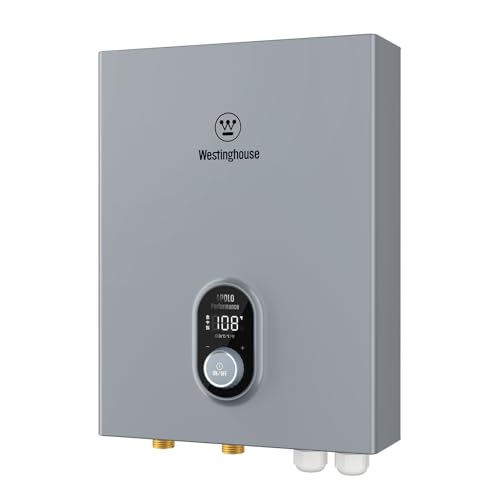
Westinghouse 24kW WiFi Tankless Water Heater
Best for: Smart homes with 100A electrical capacity
- Fuel Type
- Electric
- Flow Rate
- Max 5.55 GPM
- Wattage
- 24 kW
- Voltage
- 240V
- Certification
- ETL
- Dimensions
- 17" x 13" x 4.3"
View on Amazon: Westinghouse 24kW WiFi Tankless Water Heater Affiliate link
The Westinghouse 24kW electric unit delivers up to 5.55 GPM of hot water at 240V. It requires 100A of current and three 40A breakers. The compact 17 x 13 x 4.3-inch design mounts flush to the wall. Smart Wi-Fi lets you control temperature via an app or voice commands. It suits whole-house needs in apartments or homes.
Pros
- Delivers 5.55 GPM flow rate for simultaneous use
- Compact 17 x 13 x 4.3-inch flush-mount design
- Smart Wi-Fi with app and voice control
- Low 0.79 GPM starting flow rate
Cons
- Requires 100A electrical capacity and three 40A breakers
- Uses 8 AWG wiring which may need professional installation
- Limited to 240V voltage input
Good fit if
- You need smart app control for temperature adjustment
- You have the electrical capacity for a 100A circuit
- You want a compact unit that mounts flush to the wall
Skip if
- You do not have a 240V power supply
- Your electrical panel cannot support three 40A breakers
- You need gas-powered heating for higher flow rates
Verdict: Westinghouse 24kW Electric Tankless Heater fits homes with strong electrical infrastructure that value smart connectivity and compact wall mounting.
Specifications side by side
| Spec | Rinnai 11.1 GPM Condensing Dual-Fuel Water Heater | Westinghouse 24kW WiFi Tankless Water Heater |
|---|---|---|
| Fuel Type | Natural Gas or Propane | Electric |
| Flow Rate | 11.1 GPM | Max 5.55 GPM |
| BTU | 199k BTU | not stated |
| Wattage | not stated | 24 kW |
| Installation Location | Indoor/Outdoor | not stated |
| Voltage | not stated | 240V |
| Certification | not stated | ETL |
| Dimensions | not stated | 17" x 13" x 4.3" |
| Use | not stated | Whole House |
| Venting Type | Condensing | not stated |
| Features | not stated | WiFi |
| Weight | 55 pounds | 17 pounds |
| Size | 11.1 GPM | L-24 |
| Color | Silver | Gray 24 |
| Model | RX199iN | WET-24K-G |
Frequently asked questions
Can I install a Rinnai tankless heater myself?
You should consult local codes before attempting DIY installation. The Rinnai RX199iN is a condensing unit that requires specific venting. Its dimensions are 18.5 inches wide and 30.1 inches tall. Proper gas line sizing and venting are critical for safety and efficiency. Professional installation ensures the dual-fuel flexibility works correctly.
Does the Westinghouse heater need a dedicated circuit?
Yes, it requires a strong electrical infrastructure. The Westinghouse WET-24K-G operates at 240V and 24 kW. This high wattage demands a robust electrical panel, typically 100A capacity. You must ensure your home’s wiring can handle this load. The compact size fits wall mounting, but the electrical work is substantial.
Which brand offers better hot water flow for large families?
Rinnai provides higher flow rates for large households. The RX199iN delivers 11.1 GPM, supporting multiple simultaneous uses. This capacity suits homes needing robust hot water delivery. Westinghouse focuses on electric efficiency rather than high GPM. If you run several fixtures at once, Rinnai’s gas-powered output is more suitable.
Is the Westinghouse unit smart-enabled?
Yes, the Westinghouse WET-24K-G includes WiFi connectivity. This feature allows you to monitor and control the heater remotely. It is designed for smart homes that value digital integration. The unit weighs only 17 pounds and measures 13 inches wide. You can adjust settings via an app if compatible.
What are the physical dimensions of these heaters?
The Rinnai RX199iN is larger, measuring 18.5 inches wide and 30.1 inches tall. It weighs 55 pounds. The Westinghouse WET-24K-G is more compact, at 13 inches wide and 17.1 inches tall. It weighs just 17 pounds. Consider your available wall space when choosing between the gas condensing model and the electric unit.
Can the Rinnai heater run on propane?
Yes, the Rinnai RX199iN is a dual-fuel model. You can choose between natural gas or propane. This flexibility helps if you have existing gas lines or access to both fuels. It fits households needing robust hot water delivery with flexible placement options. The condensing design enhances efficiency regardless of the fuel source selected.