Installation Location Explained: What It Means for Tankless Water Heaters
As an Amazon Associate we earn from qualifying purchases. Links on this page are affiliate links.
Understanding Installation Location Options
The installation location explained clarifies where a unit operates safely. You must choose between indoor and outdoor models. This choice dictates placement, weather protection, and piping needs. It is a critical decision before purchase.
Indoor units require a vented space. They need a clear path for exhaust gases to leave your home. Most models use concentric venting through an exterior wall. Some older designs use two separate pipes. You must ensure the room has adequate combustion air. Building codes often specify minimum distances from windows or doors. These units fit in garages, basements, or utility closets. They are not for living spaces or bedrooms. Proper ventilation prevents carbon monoxide buildup. This is non-negotiable for safety.
Outdoor units are built for exposure. They withstand rain, snow, and sun. Manufacturers use corrosion-resistant materials like stainless steel. You can mount them on an exterior wall. This saves interior square footage. You do not need complex venting systems in many cases. Some models use direct venting, while others are atmospheric. Check the manual for specific clearance requirements. Keep the area clear of debris and snow. Ensure the unit is level and secure. Freezing temperatures can damage pipes if not protected. Some models include freeze protection, but others do not. Verify this feature if you live in a cold climate.
Why does this matter to you? It affects your home’s layout. Indoor units require professional venting installation. This adds to labor costs. Outdoor units are easier to place but may need electrical upgrades. You must also consider noise. Indoor units are quieter. Outdoor units can be heard from patios or windows. Check the decibel rating on the spec sheet. Your local code will also restrict placement. Always consult a licensed plumber or technician. They can assess your specific home structure. The wrong location leads to inefficient operation or safety hazards. Choose the right spot for long-term reliability.
Indoor vs Outdoor Tankless Units
Indoor
Indoor installation requires a dedicated, vented space within your home. This location protects the unit from weather but demands proper airflow and exhaust routing. You need access to gas lines or high-capacity electrical circuits. Indoor units often offer higher flow rates for whole-house use. The Ranein 4.3 GPM Propane model fits busy households with indoor propane access. Its copper heat exchanger provides steady hot water. The Thermomate 18kW Electric unit suits homes with strong electrical infrastructure. These units are not for renters or outdoor use. You must ensure the space meets local building codes for ventilation and clearance. This setup is ideal for permanent, high-demand residential applications.
Outdoor
Outdoor installation places the unit outside your home. This saves indoor space and eliminates the need for complex venting through walls. The unit must withstand rain, sun, and temperature fluctuations. You need a secure mounting location with easy access to fuel lines. Outdoor models are often lighter and portable. The Camplux 5L Portable Propane Heater is a lightweight solution for campers. It operates on battery power without electricity. The Camplux BW211 is a CSA-approved option for camping tasks. These units fit outdoor cleaning or showering needs. They lack the flow and indoor versatility of fixed units. This option suits RVers and those needing temporary hot water. Ensure the location is protected from direct wind if possible.
Who Needs Indoor Or Outdoor?
Who needs it
You must prioritize installation location if your home lacks adequate ventilation for gas exhaust. Indoor units require a dedicated space with proper airflow and a clear path for venting combustion gases. This is non-negotiable for safety. If you live in a climate with freezing temperatures, an outdoor unit might freeze unless it has specific freeze protection features. You need to check local building codes regarding exterior placement. Also, consider noise. Indoor units are quieter but need space. Outdoor units are exposed to weather but save interior square footage. If you have limited interior space but a suitable exterior wall, an outdoor model fits your needs. Verify that your chosen spot has access to gas lines or high-capacity electrical circuits. This spec dictates your entire piping strategy and placement options.
Who can skip it
You can ignore this specific spec if you are replacing an existing tankless water heater in the same location. The current installation already meets your ventilation and utility requirements. Focus instead on flow rate and temperature rise specs to ensure the new unit meets your household demand. If you are upgrading from a traditional tank, consider the overall capacity and energy efficiency ratings first. The installation location remains a fixed constraint based on your existing infrastructure. Prioritize specs that affect daily performance, such as gallons per minute and maximum temperature increase. These factors determine whether you have enough hot water during peak usage times. The physical placement is a secondary concern once you know your utility access points. Stick to the existing indoor or outdoor setup to avoid costly remodeling or new venting installations. This keeps the project simple and within your existing structural boundaries.
Key Installation Terms
Fuel Type
The energy source used, such as natural gas, propane, or electricity. This choice determines the required connections and safety clearances for your specific home setup.
Installation Location
Whether the unit is placed indoors or outdoors. This decision impacts weather protection needs and the complexity of venting and piping required for safe operation.
Use
The intended application, such as point-of-use for a single sink or whole-house service. This defines the capacity needed to meet your household hot water demands.
Venting Type
The method for exhausting combustion gases, like power vent or direct vent. Proper venting is critical for indoor safety and must match the unit's specific requirements.
Capacity
The maximum volume of hot water the unit can produce, measured in gallons per minute. This spec ensures the heater meets your peak usage needs.
Flow Rate
The speed at which water passes through the heater, typically measured in GPM. Higher flow rates allow multiple fixtures to run simultaneously without losing temperature.
Wattage
The electrical power consumption for electric models, measured in watts. Higher wattage generally supports greater flow rates but requires robust electrical circuits in your home.
Quick picks
| # | Product | Best for | Price |
|---|---|---|---|
| 1 | Ranein 4.3 GPM Indoor Propane Tankless Water Heater | Indoor multi-fixture propane setups | Check price of Ranein 4.3 GPM Indoor Propane Tankless Water Heater on Amazon |
| 2 | Camplux 5L Portable Propane Water Heater | Camping and off-grid outdoor showers | Check price of Camplux 5L Portable Propane Water Heater on Amazon |
| 3 | Thermomate 18kW Electric Tankless Water Heater | high-flow indoor electric needs | Check price of Thermomate 18kW Electric Tankless Water Heater on Amazon |
| 4 | Camplux 2.11 GPM Portable Outdoor Propane Water Heater | camping and outdoor portable hot water | Check price of Camplux 2.11 GPM Portable Outdoor Propane Water Heater on Amazon |
| 5 | ThermoMate 14kW Electric Tankless Water Heater | tight indoor spaces with 60 Amp electrical capacity | Check price of ThermoMate 14kW Electric Tankless Water Heater on Amazon |
| 6 | VEVOR 4.3 Gal Natural Gas Tankless Water Heater | indoor whole-house hot water needs | Check price of VEVOR 4.3 Gal Natural Gas Tankless Water Heater on Amazon |
Our 6 picks

Ranein 4.3 GPM Indoor Propane Tankless Water Heater
Best for: Indoor multi-fixture propane setups
- Installation Location
- Indoor (what this guide is about)
- Fuel Type
- Propane Gas
- Flow Rate
- 4.3 GPM
- BTU
- 100,000 BTU
- Temperature Control
- 95°F-155°F
- Dimensions
- 22.5 x 14.2 x 14.2 inches
View on Amazon: Ranein 4.3 GPM Indoor Propane Tankless Water Heater Affiliate link
This Ranein unit delivers 4.3 GPM at 100,000 BTU for indoor propane heating. It features an oxygen-free copper heat exchanger and precise temperature control from 95°F to 155°F. The device includes four preset modes and anti-freeze protection down to 14°F. It comes with a vent pipe for installation. This model suits households needing reliable hot water for multiple fixtures simultaneously.
Pros
- 4.3 GPM flow rate supports 3-4 water points
- Oxygen-free copper heat exchanger for durability
- LED display with temperature memory function
- Anti-freeze protection down to 14°F
- Includes vent pipe for indoor installation
Cons
- Indoor installation only requires professional setup
- Not suitable for elevations above 2,000 feet
- Limited to propane fuel type only
Good fit if
- You need hot water for multiple simultaneous uses
- You have an existing indoor propane connection
- You want precise temperature control with presets
Skip if
- You require outdoor installation capability
- You live above 2,000 feet elevation
- You prefer natural gas over propane
Verdict: Ranein 4.3 GPM Propane Indoor Heater provides steady hot water for busy households with indoor propane access. Its copper heat exchanger and anti-freeze features make it a solid choice for multi-fixture homes.

Camplux 5L Portable Propane Water Heater
Best for: Camping and off-grid outdoor showers
- Installation Location
- Outdoor (what this guide is about)
- Fuel Type
- Propane
- Flow Rate
- 1.32 GPM
- Certification
- CSA
- Dimensions
- 4.33 x 11.4 x 14.8 inches
- Use
- Camping, RV
View on Amazon: Camplux 5L Portable Propane Water Heater Affiliate link
This outdoor propane unit delivers 1.32 GPM of instant hot water. Weighing only 10 pounds with a folding handle, it fits easily in cars or RVs. It starts at 3.0 PSI, allowing use with small pumps or gravity bags. CSA certified with six safety protections, it suits camping, RV trips, and off-grid cabins where electricity is unavailable.
Pros
- 1.32 GPM flow rate for instant hot water
- Low 3.0 PSI water pressure start requirement
- Lightweight 10-pound design with folding handle
- CSA certified with 6-in-1 safety protections
- No electricity needed for operation
Cons
- Low 1.32 GPM flow rate limits simultaneous use
- Requires 2 D-size batteries for ignition
- Outdoor-only installation limits weather exposure
Good fit if
- You need hot water for camping or RV trips
- You are in an off-grid location without electricity
- You want a lightweight unit for easy transport
Skip if
- You need high flow rates for multiple fixtures
- You require indoor installation for permanent mounting
- You want a unit that does not need batteries
Verdict: Camplux 5L Portable Propane Heater is a lightweight, battery-operated solution for campers and RVers who need reliable outdoor hot water without electricity.
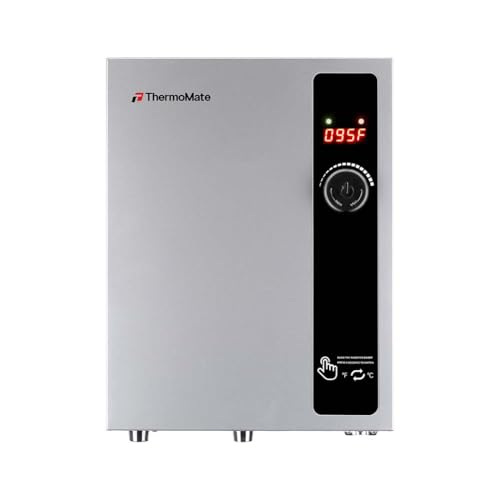
Thermomate 18kW Electric Tankless Water Heater
Best for: high-flow indoor electric needs
- Installation Location
- Indoor (what this guide is about)
- Fuel Type
- Electric
- Flow Rate
- Up to 4.4GMP
- Wattage
- 18kW
- Voltage
- 240V
- Temperature Control
- 80°F to 140°F, ±1°F
View on Amazon: Thermomate 18kW Electric Tankless Water Heater Affiliate link
This indoor electric unit delivers up to 4.4 GPM at 18kW. It mounts on the wall to save space. The digital display adjusts temperature in 1-degree increments from 80°F to 140°F. It requires two 40-amp breakers and 8AWG wire. You need a 240V circuit. This heater suits homes with adequate electrical capacity.
Pros
- High flow rate of 4.4 GPM
- Precise 1-degree temperature adjustment
- Compact wall-mounted design
- ETL certified for safety
Cons
- Requires two 40-amp double-pole breakers
- Needs 8AWG wiring gauge
- Indoor installation only
Good fit if
- You have a 240V electrical panel
- You need high flow for multiple fixtures
- You want precise temperature control
Skip if
- You only have 120V outlets
- You need outdoor installation
- You cannot run 8AWG wire
Verdict: Thermomate 18kW Electric Tankless Heater fits homes with strong electrical infrastructure. It provides reliable hot water for busy bathrooms. It is not for renters or outdoor use.

Camplux 2.11 GPM Portable Outdoor Propane Water Heater
Best for: camping and outdoor portable hot water
- Installation Location
- Outdoor (what this guide is about)
- Fuel Type
- Propane
- Flow Rate
- 2.11 GPM
- BTU
- 55,000 BTU/hr
- Temperature Control
- 18-95 °F
- Certification
- CSA
View on Amazon: Camplux 2.11 GPM Portable Outdoor Propane Water Heater Affiliate link
The Camplux BW211 is a 55,000 BTU propane unit designed for outdoor use. It delivers up to 2.11 GPM with a temperature range of 18-95 °F. Weighing 19 pounds, it runs on standard 20 lb tanks and 2 D-cell batteries for ignition. CSA approval ensures safety. This compact heater suits campers and outdoor tasks where portability matters more than high flow.
Pros
- 55,000 BTU/hr power output
- Maximum flow rate of 2.11 GPM
- Lightweight 19-pound design for portability
- CSA safety certified
- Operates on standard 20 lb propane tanks
Cons
- Lower flow rate compared to indoor models
- Requires 2 D-cell batteries for ignition
- Limited to outdoor installation only
Good fit if
- You need a portable heater for camping trips
- You require hot water for outdoor cleaning tasks
- You want a CSA-approved unit for rural use
Skip if
- You need indoor installation for a home
- You require high flow rates for multiple fixtures
- You prefer electric ignition without batteries
Verdict: Camplux BW211 Portable Propane Heater is a lightweight, CSA-approved option for campers needing portable hot water. It fits outdoor tasks like cleaning or showering but lacks the flow and indoor versatility of fixed units.

ThermoMate 14kW Electric Tankless Water Heater
Best for: tight indoor spaces with 60 Amp electrical capacity
- Installation Location
- Indoor (what this guide is about)
- Fuel Type
- Electric
- Flow Rate
- 3.4 GPM
- Wattage
- 14 kW
- Voltage
- 240 V
- Temperature Control
- 86°F to 131°F
View on Amazon: ThermoMate 14kW Electric Tankless Water Heater Affiliate link
This indoor electric unit delivers up to 3.4 GPM at 14 kW. It requires a 240V, 60 Amp circuit with 6 AWG wiring. The compact 15.9 x 11.2 x 3 inch design fits tight spaces. It heats water between 86°F and 131°F for one or two fixtures. You get stable temperature control and ETL safety certification. This model suits small homes or apartments with adequate electrical capacity.
Pros
- 14 kW power output provides up to 3.4 GPM
- Compact dimensions: 15.9 x 11.2 x 3 inches
- ETL listed for UL-499 and CAN/CSA-C22.2 safety
- Smart modulation maintains stable temperature from 86°F to 131°F
Cons
- Requires a dedicated 60 Amp double-pole circuit breaker
- Needs 6 AWG copper wiring for installation
- Limited to indoor installation only
Good fit if
- You have a 240V electrical panel with 150 Amp total capacity
- You need hot water for one or two fixtures simultaneously
- You are installing in a tight indoor space like a closet
Skip if
- You only have a 200 Amp main panel with limited breaker space
- You need to run three or more fixtures at once
- You require an outdoor-rated unit for exterior mounting
Verdict: ThermoMate 14kW Electric Tankless Heater offers reliable indoor performance for small households with strong electrical infrastructure. It fits buyers who need compact, safe heating for limited simultaneous use.

VEVOR 4.3 Gal Natural Gas Tankless Water Heater
Best for: indoor whole-house hot water needs
- Installation Location
- Indoor (what this guide is about)
- Fuel Type
- Gas
- BTU
- 100,000 BTU/hr
- Capacity
- 4.3 Gal
- Temperature Control
- ±1°F
- Dimensions
- 21.7 x 13.8 x 13.8 inches
View on Amazon: VEVOR 4.3 Gal Natural Gas Tankless Water Heater Affiliate link
This VEVOR unit delivers 100,000 BTU/hr for indoor whole-house use. It holds 4.3 gallons of water and maintains temperature within ±1°F using smart sensors. An LED display shows real-time status and settings. You get multiple safety protections, including anti-freeze and wind pressure resistance. The standard 1/2 inch NPT connector simplifies direct vent connection for your installation.
Pros
- 100,000 BTU/hr heating output
- ±1°F precision temperature control
- LED display with touch panel
- Multiple safety protections included
Cons
- Indoor installation only
- Requires direct vent connection
- Heavier at 19.8 pounds
Good fit if
- You need indoor whole-house heating
- You want precise temperature stability
- You have a direct vent setup
Skip if
- You need outdoor installation
- You want portable camping use
- You require propane fuel
Verdict: VEVOR 4.3 Gal Natural Gas Indoor Heater fits homes needing stable indoor hot water with precise temperature control and robust safety features.
Specifications side by side
| Spec | Ranein 4.3 GPM Indoor Propane Tankless Water Heater | Camplux 5L Portable Propane Water Heater | Thermomate 18kW Electric Tankless Water Heater | Camplux 2.11 GPM Portable Outdoor Propane Water Heater | ThermoMate 14kW Electric Tankless Water Heater | VEVOR 4.3 Gal Natural Gas Tankless Water Heater |
|---|---|---|---|---|---|---|
| Fuel Type | Propane Gas | Propane | Electric | Propane | Electric | Gas |
| Flow Rate | 4.3 GPM | 1.32 GPM | Up to 4.4GMP | 2.11 GPM | 3.4 GPM | not stated |
| BTU | 100,000 BTU | not stated | not stated | 55,000 BTU/hr | not stated | 100,000 BTU/hr |
| Wattage | not stated | not stated | 18kW | not stated | 14 kW | not stated |
| Installation Location | Indoor | Outdoor | Indoor | Outdoor | Indoor | Indoor |
| Capacity | not stated | not stated | not stated | not stated | not stated | 4.3 Gal |
| Voltage | not stated | not stated | 240V | not stated | 240 V | not stated |
| Temperature Control | 95°F-155°F | not stated | 80°F to 140°F, ±1°F | 18-95 °F | 86°F to 131°F | ±1°F |
| Certification | not stated | CSA | ETL | CSA | ETL | not stated |
| Dimensions | 22.5 x 14.2 x 14.2 inches | 4.33 x 11.4 x 14.8 inches | 17.12" x 13.12" x 3.12" | 20.5 x 12.6 x 12.6 inches | 15.9" x 11.2" x 3" | 21.7 x 13.8 x 13.8 inches |
| Use | Whole House | Camping, RV | not stated | Camping | not stated | Whole House |
| Features | not stated | Overheat Protection | not stated | not stated | not stated | not stated |
| Weight | not stated | 10 pounds | not stated | 19 pounds | 13 pounds | 19.8 pounds |
| Size | 4.3GPM Indoor | Classic | 240V/18kW | not stated | not stated | 4.3 Gal |
| Color | LPG | White | Gray | White | Gray | Silver Gray |
| Model | RANEIN-43GPM-100KBTU | AY132 | ET180 | BW211 | EH140 | JSQ30-A |
Frequently asked questions
Can I install a propane tankless heater in my garage?
Yes, if you select an indoor-rated model. The Ranein 4.3 GPM unit is designed for indoor propane setups. It includes anti-freeze features and a copper heat exchanger. Ensure your garage has proper ventilation and meets clearance requirements for safe operation.
Do outdoor units need electricity to run?
Not necessarily. The Camplux 5L Portable model runs on propane and battery power. It is ideal for camping or off-grid showers. This design allows you to use it outdoors without connecting to a household electrical circuit, providing flexibility for remote locations.
What electrical capacity do I need for an indoor electric heater?
You need a strong electrical infrastructure. The Thermomate 18kW model requires 240V power. It is not suitable for renters or outdoor use. Ensure your home has the necessary amp capacity to support the high wattage demand for reliable hot water delivery.
Is a portable outdoor heater suitable for whole-house use?
No, portable units lack the flow rate for whole homes. The Camplux BW211 is CSA-approved for camping and outdoor tasks. It provides limited hot water suitable for cleaning or showering. It does not offer the flow and versatility of fixed indoor units.
How large is a typical indoor electric tankless unit?
Indoor electric models are compact. The Thermomate 14kW unit measures 11.2 inches wide and 15.9 inches high. It weighs 13 pounds. This size fits tight indoor spaces with 60 Amp electrical capacity, making it safe for limited simultaneous use in small households.
Can I use natural gas for indoor whole-house heating?
Yes, indoor natural gas units are designed for this. The VEVOR 4.3 Gal model provides stable indoor hot water. It features precise temperature control and robust safety features. This setup is ideal for homes needing consistent whole-house hot water with natural gas access.